Sunday, February 20, 2011

Alumna revisits University of Santo Tomas during 400th founding anniversary celebration


By Nancy T. Lu
A Tomasian does not forget. This one certainly remembers.

Memories of four formative years spent as a journalism student in the Manila campus of the Pontifical and Royal University of Santo Tomas – particularly in the Faculty of Arts and Letters – returned in a flash on this particular Saturday in February picked for a revisit.

The Artlets alumni were gathering for a general homecoming in the Quadricentennial Square between the Main Building and the Miguel de Benavides Library on February 19. The area due to the transformation over the years was unfamiliar to this alumna, who spent the last 25 years practicing journalism in Taiwan. (The library building received substantial donation from the Chiang Ching-kuo Foundation in Taiwan years ago when Ma Soo-lay, a Tomasian, was still an influential senior policy adviser to then President Lee Teng-hui in Taiwan. In fact, as a result of the donation, a professorial chair was created. A collection of replicas of treasures at the National Palace Museum was also turned over to UST.)

The much-publicized QuattroMondial, a bronze masterpiece created by sculptor Ramon Orlina in celebration of the 400th founding anniversary of UST this year, stood dominating the open-air site cordoned for the Artlets alumni homecoming.


Four figures on the work of art were described as representing four centuries of Excellence, Spirituality, Tradition and Erudition. Piolo Pascual, a very popular entertainment celebrity, was the model for the male student symbolizing Excellence. Charlene Gonzales, a beauty queen and psychology graduate from UST, lent her face to the female student suggesting Erudition. The Rev. Fr. Rolando de la Rosa, O.P., rector of UST, provided the look of Spirituality and Monina Orlina, the sculptor’s daughter and an academician, gave her visage to the figure standing for Tradition.


The Artlets homecoming unfolded within view of the St. Raymund’s Building (more familiar to this UST graduate as the A.B./Commerce Building). The Faculty of Arts and Letters was housed in the beginning in the Main Building, an engineering feat of Fr. Roque Ruano, O.P. This first building in the UST campus facing Espana Street was said to be earthquake-resistant.

The UST campus started by the Spanish Dominican friars was originally in Intramuros or the Walled City. The Japanese occupation forces even used the Main Building as an internment camp during World War II, lending a grim note to the history of the campus with entrances also on Dapitan Street at the back and P. Noval and Arsenio H. Lacson (formerly Governor Forbes) Streets on the two other sides.

The stern-looking Fr. Tomas Martinez, O.P. was dean in the early years of the Faculty of Arts and Letters and the more approachable Fr. Florencio Testera, O.P. served as assistant dean. This reporter in the original Rey Datu-led staff of the Flame, the official publication of the Faculty of Arts and Letters, moved over to the Varsitarian, the university magazine, in the succeeding years, interviewing, among others, the ever-perspiring Fr. Jesus Merino, O.P. about the collection of artifacts of the Museum of Arts and Sciences gathering dust deep inside the Main Building. Bernardo Bernardo, who was the Varsitarian editor then, was also into stage acting. In fact, he went on to join Zeneida Amador and Repertory Philippines in a number of theater productions. He also acted in movies. Alfredo Marquez, who succeeded Bernardo Bernardo as Varsitarian editor, went on years later to work for the People's Journal.

Years ago, segregation of the sexes was a rule enforced in the use of the stairs at UST, a Catholic institution of learning. The female students, who had to negotiate the corridors of the Main Building, avoided Fr. Nestor Mata, O.P., the strict prefect of discipline, if they were wearing sleeveless dresses because violation of the acceptable dress code meant being reprimanded for indecency on the spot.

Bishop Miguel de Benavides, O.P. bequeathed the fund and his personal library collection, paving the way for the establishment of the University of Santo Tomas in 1611, His bronze statue in front of the Main Building was done in Paris in 1889 and first made its appearance in Intramuros in 1891. Statues representing the virtues of Faith, Hope and Charity as well as Shakespeare, Dante, and St. Augustine, among others, were said to have been introduced on the building in the 1950s. Fine arts students over the years were often seen doing on-the-spot painting of the façade of the Main Building and the statues there.


The Arch of the Centuries near the gate on Espana Street (which easily got flooded during the rainy season to the chagrin of the students) was another favorite site of fine arts students. It was originally erected and remained at the entrance of the UST campus in Intramuros until 1941.

The Fountain of Knowledge to the left of the Arch of Centuries and the Fountain of Wisdom to the right were fondly remembered as bubbling attractions at the start of a tree-lined walk to the Main Building. One fine day, a bunch of giggling Artlets students (including this then undergraduate) decided to negotiate the partly shaded stretch barefoot or unshod, unmindful of the stares of passersby.

Memories of the Main Building also included Varsitarian meetings held in a ground floor office. Occasionally a staffer would hail the sorbetero or ice cream vendor to a corner window and coerce somebody to give everyone a “dirty ice cream” treat on a hot day. Pay day – meaning the day when allowances of Varsitarian staffers were released – was when everyone would turn up.

At “Artlets’ bash at full blast,” this writer picked up a copy of Rated A only to learn of the fairly recent demise of Professor Milagros Tanlayco and Professor Ophelia Alcantara-Dimalanta. Professor Tanlayco in her chattering style taught English and literature. She would arrive in class with diaphanous fabric softly trailing after her. As for Professor Dimalanta, she taught short story writing but was herself a poetess of renown.

There was one professor whom this Artlets graduate admired and tracked down many years later in Seattle, Washington. Professor Erlinda Rustia taught aesthetics and literary criticism. One quiz she gave required comparing the operatic singing of Maria Callas and Renata Tebaldi.

Journalism subjects in those days were handled mostly by the late newspaperman Felix Bautista. He was also adviser to the staffers of the Flame and the Varsitarian. His lectures were peppered with interesting first-hand anecdotes. Julie Yap Daza, a Tomasian and a columnist presently connected with the Manila Bulletin, taught public relations. When press obligations kept her away, she sent over her husband, a PR practitioner.

Tuition in those days was less than 300 pesos per semester. A senior at the Faculty of Arts and Letters revealed that it has gone up to 30,000 pesos per semester. Inflation has indeed caught up with Philippine education. The more exclusive Catholic universities are reportedly even charging about 100,000 pesos per semester.

UST is planning to build new campuses in Sta. Rosa, Laguna, and in General Santos City. South Cotabato.

Thursday, February 3, 2011

Song legend Teresa Teng comes alive in Celebrity’s House at Taipei Flora Expo


By Nancy T. Lu

Teresa Teng is a name which fans memory of many popular Chinese love ballads. “The Moon Represents My Heart” can be cited as a classic example. Her rendition of this song in a sweet and caressing voice touches listeners and puts all in a romantic mood long after her passing.

The memory of this song legend whose 58th birth anniversary fell on January 29 this year makes a visit of the Celebrity’s House at the ongoing Taipei International Flora Exposition (Taipei Flora Expo) worthwhile. Nostalgia overwhelms a visitor as song after song plays inside in Mandarin, Cantonese, Japanese and English. Pictures and video presentations capture highlights from her lifetime with fond remembrance.

Red roses said to be Teresa Teng’s favorite flower greet those privileged to enter Celebrity’s House. Floral artist Lin Hui-lee was responsible for introducing preserved roses and transforming an area into a rose-covered setting.

Only a limited number of visitors are accommodated each day at Celebrity’s House. Special entrance tickets are distributed outside early every morning.


Roses on an interactive, multi-touch screen give way to an emerging Teresa Teng near the entrance. Teng’s life story is then told in phases complete with representative pictures.

The displayed memorabilia of the enduring song artist includes her clothes, her Louis Vuitton luggage, trophies, record albums over the years, personal jottings, letters and her signatures in Chinese, English and Japanese.


A pop-up image of Teng dominates a stage with a microphone. Tourists are able to have souvenir pictures taken here.

Nearby, people queue to have their pictures taken as featured Celebrity's House cover personalities and to have even just briefly a taste of instant fame. Visitors can later go online and download files showing them as publication cover subjects.


The final moments of a visit are generally spent viewing a documentary of Teresa Teng mainly in concert. Long after every screening, the spectators linger – in fact, craving for more of Teresa Teng and her sweet and gentle but sad singing.


The Taipei International Flora Exposition at the Yuanshan Park Area, Fine Arts Park Area, Xinsheng Park Area and Dajia Riverside Park Area opened on November 6, 2010, and will run until April 25, 2011. The Celebrity’s House is at the Yuanshan Park Area.

Sunday, January 23, 2011

Award-winning New Year print designs celebrate Year of Rabbit and Republic of China’s founding centennial


By Nancy T. Lu

Good wishes spring forth and multiply fast when the Lunar New Year approaches. The Year of the Rabbit has inspired many original New Year Prints and all of them have been conceived and created to convey absolutely auspicious messages.

As in the past, the Council for Cultural Affairs through the Taiwan Museum of Art has singled out to honor with awards the finest entries in the latest search for New Year prints inspired primarily by the Year of the Rabbit.

Of the top six entries, Lu Yan-hui’s “The Rabbit Takes Off and Advances with Vigor” shows an abstract rabbit outline against a background of peony-covered Taiwan fabric. In Chinese culture, the peony is the king of flowers. It is also the flower of riches and honor. It finds its place as one of the flowers representing the four seasons. It, in fact, it is associated with spring. The peony, too, is recognized as an emblem of love and affection as well as a symbol of feminine beauty.

Chen Mei-yun’s “Auspicious Rabbit Celebrates Centennial” goes all out in heralding the 100th anniversary of the founding of the Republic of China (ROC) on Taiwan. A peony appears on the upper right corner of the flag. In the lower right is a rabbit with the Chinese character for “spring” on it. “Chun” when read in Mandarin is a homonym of the Taiwanese word for “surplus” or “abundance.”

Meanwhile the peach of longevity and the “ru yi” (“as you wish”) scepter likewise convey greetings most appreciated at the start of a new year. The plum blossom, chosen as the national flower of the ROC because of its five petals representing five clans (Chinese, Manchus, Mongolians, Mohammedans and Tibetans) and “Five Power Constitution” of the Chinese Republic, springs forth on a leafless tree branch in winter.


Chen Qiao-yu’s “Ten Thousand Rabbits of Good Fortune Welcome Century Milestone” features plum blossoms on four corners. Red, a hue reserved for happy and festive occasions, is the only color used in this New Year Print launched in a historical year.


Huang De-cheng’s “Good Persimmons Multiply Twofold” carries the message of joy spreading in the New Year. As a bright-colored fruit symbolizing joy in Chinese culture, the persimmon appears often on Chinese cups and bowls.


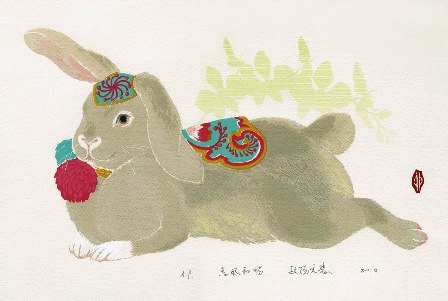
Ouyang Wen-hui’s “A Gentle Breeze is Freely Blowing” highlights a furry and playful rabbit sprawled in familiar and comfortable environment, thereby summing up the mood and spirit in the year ahead.

Cai Chun-yi’s “Jade Rabbit Announces Good News” captures the mood of a nation turning 100. Exploding fireworks on the Taipei 101 landmark usher in a year of celebration in exciting color. Taiwan keeps moving forward with power and speed like the bullet train on the high-speed rail.

Happy Year of the Rabbit to all!

Thursday, January 20, 2011

Rabbit seen only through a magnifying glass emerges from miniaturist Chen Forng-shean's hands to delight everyone


By Nancy T. Lu

Most people aim big in their endeavors. Chen Forng-shean has chosen to be different, devoting a lifetime to the pursuit of the opposite. The creation of scaled-down objects is his obsession. In fact, the smaller the size of the item, the greater the satisfaction it brings him.

Chen, a rare find, is a miniaturist from Xinchu, Taiwan. As the Lunar New Year approaches each year, he unveils his delightful masterpieces, which are often inspired by the zodiac animal of the year. They are barely visible to the naked eye

To welcome the Year of the Rabbit, he took resin and transformed it into “the world’s smallest rabbit.” Take note: the lovable creature measures only 0.5 mm in size. It is even more tiny than the eye of a sewing needle. Chen spent three months to produce a carrot-eating bunny. The rabbit, including its facial expression, can only be seen and appreciated under a magnifying glass.

Chen had the native rabbit in mind when he buckled down to make his rabbit conversation piece. He described the furry white animal as having a cleft palate, developed front teeth, short tail, long ears, short front legs and longer hind legs.

In the past three decades, Chen Forng-shean has built an amazing collection of miniature items. He displays many of them in his private museum at No. 17, Lane 207, Ankang Road, Sec. 1, Xinchu City. All those who have had the privilege of dropping by have been totally impressed by his skill. His accomplishments are indeed for the Guinness Book of World Records.

Thursday, January 13, 2011

Breton singer Yann-Fanch Kemener traces trail of “Nan Kuan” expert Tsai Hsiao-yueh, later meets designer Sophie Hong and erhu artist Liang Wen-pin


By Nancy T. Lu
East is East and West is West. But artists of different art forms and genres can make the meeting of the two happen with interesting result.


Yann-Fanch Kemener, one of the best-known voices from Brittany in France, touched down on Taiwan soil for the first time in December for a two-week visit. The specialist in traditional vocal music called “Kan Ha Diskan” (translated “call and response singing”) headed straight for Tainan to trace the trail of Tsai Hsiao-yueh, a singer of the most refined ancient Chinese music called “Nan Kuan” (southern pipe).


Tsai did a first recording of “Nan Kuan” ballads with an ensemble of musicians from Nansheng Association for Radio France in Paris in 1982. The critical acclaim received by this first “Nan Kuan” music album led to subsequent recordings for two more volumes in September and October 1991.

Kemener, himself involved in Breton roots revival, spoke in Taipei of his great admiration for Tsai’s traditional singing whom he first heard through her “Nan Kuan” recordings. He had made the special trip to the southern city of Tainan in Taiwan to hpoefully find her and interact with her. But he never met her. Instead he had very friendly encounters with people who knew her. In fact, he encountered Chen Hung-ming, a 92-year-old pipa or lute player who was in Tsai's entourage of musicians when she went to do recordings for Radio France in Paris thrice.

Kemener, one of just a handful of existing recognized mentors in traditional Breton singing, has likewise done many professional recordings of ballads in a language which he described as of Celtic origin and totally different from French. He performs in live concerts usually with a cellist or a pianist.

Born in Sainte-Tréphine (Côtes-d'Armor) in 1957, Kemener participated in the revival of the Kan Ha Diskan in the 1970s and 1980s. He helped in preserving the traditional songs by collecting and singing them in his beautiful and powerful voice. In Taipei, he expressed his interest in finding a publisher for a collection of 200 ballads in due time.

Kemener hailed from a family of tillers of the soil. Although exposed to a life of hardships, he found everyday joy in singing. Traditional singers of Brittany particularly fascinated him from childhood. He listened closely, eventually even taping their singing.


While in Taipei, Kemener tracked down top Taiwanese fashion designer Sophie Hong whose chic clothes he first discovered in Brittany and, in fact, has taken to wearing in his concerts and public appearances in the last 10 years. At Sophie Hong’s boutique in Taipei, he shopped to his heart’s content for his new wardrobe fashioned out of Chinese silk treated and processed using an ancient method for his coming performances in France.

One evening Sophie Hong invited him to dinner at the famous teahouse and restaurant with history called Wistaria. The setting was once the hub of workers in Taiwan’s earliest democracy movement. Christophe Gigaudaut, the French diplomat overseeing cooperation and cultural affairs for the French Institute in Taipei, joined them.


Sipping of aged Puerh tea circa 1950 from Lanchang -- said to have been wrapped and kept dry in a special straw mat of the region – combined with erhu music entertainment by Liang Wen-pin, a gifted artist of the two-string instrument and also a conductor of at least two Chinese orchestras in Taiwan, made the East-West encounter truly memorable for all.


After bowing classical Chinese musical notes inspired by the romance of the “Butterfly Lovers” Liang Shan-po and Chu Ying-tai, the erhu artist ventured into music suggesting the excitement of horsing around.

The moment finally came for Kemener to fill the air with his Breton style of singing. He sang in his native dialect and Liang caught up with him in his music-making by repeating his tune like a refrain after him. Was this like the “Kaner” singing and the “Diskaner” responding in a unique performance of “Kan Ha Diskan”? .

Kemener was drunk not with whisky nor with the special tea poured for him. He felt overwhelmed by the experience of traditions of East and West meeting in his rendezvous with newfound friends in Taiwan.

He earnestly expressed interest in returning despite his fear of flying to teach and conduct a workshop in his area of musical expertise.

Friday, December 10, 2010

Starry, Starry Night – from UNICEF Christmas card artist Manuel D. Baldemor


By Nancy T. Lu

Generosity gets manifested in many wonderful ways at Christmastime. Famous artists around the world, for example, offer the reproduction rights to their paintings to the United Nations Children’s Fund. Corporate interest in buying UNICEF Christmas cards to contribute to efforts to help malnourished and impoverished children around the world has been sustained over the years despite the trend to go for digital cards because the colorful greeting cards feature designs with great appeal.


To look at the paintings of Philippine-born artist Manuel D. Baldemor is to understand readily why his works revolving around the festive Christmas theme have been selected for reproduction on UNICEF cards over the years.

Every labor of love coming out of Baldemor’s atelier in Pasig, Metro Manila, feels very much like Christmas. He fills his Philippine Christmas landscape with traditional Philippine Christmas lanterns, which hang on windows and in front of homes at this time of the year. The star-shaped decorations shine beautifully in the night. The bright and exciting colors from Baldemor’s palette spread the joy of the season.


Traditions are very close to the heart of this 63-year-old native of the famous woodcarving town of Paete in Laguna province. He portrays Filipino farmers from the countryside taking time out to go and hear the Midnight Mass on Christmas Eve. Some show up even on the backs of water buffalos. The colorful Philippine jeepney likewise brings people to church. Vendors balancing baskets of food for the Noche Buena on their heads also find their way into his paintings.

Baldemor’s stylized depictions of Christmas celebration remind viewers that Christmas is a religious feast in predominantly Catholic Philippines. The façade of a house of worship – often Baldemor’s hometown church – is incorporated into his art composition from time to time. The Filipino family, too, gets highlighted in his well thought out art expression about Christmas. He paints townsfolk looking out of the windows of their homes.

The titles, which Baldemor gives his paintings, tell about the traditional Filipino culture, which fascinates him and which he holds dear. These include: “Pasko Sa Aming Bayan (Christmas in the Philippines),” “Season of Hope,” “Stars,” “Lantern Festival,” “Stars of Good Blessing,” “Midnight Mass” and “Filipino Family.”


The generous Baldemor has contributed at least 15 designs to UNICEF cards since 1986. Some of the original paintings are still in his personal collection.

The processing of a work of art for use on a UNICEF card takes about four years. A slide of the painting is sent to the UNICEF head office in New York for evaluation. The actual painting is never brought over there.

Greeting cards featuring Baldemor’s paintings have all been best-sellers. Such knowledge truly fills the painter’s heart with happiness.

Baldemor, in fact, created a mural titled “Pasasalamat” (Thanksgiving”) for the lobby of the UNICEF Building in Vienna, Austria. The mixed media masterpiece even required Baldemor to bring 50 kilos of lahar sand to Vienna. It was unveiled in 1998.

The friendly and outgoing Baldemor is not just a painter but also a sculptor, printmaker, and book illustrator. At the age of 12, he was already a “master carver” in Paete. Years ago, he even dabbled in ceramic tile design.

Baldemor studied fine arts at the University of Santo Tomas in Manila. He went on to win painting competitions and represent his country at international exhibitions like the Salon International Art in Paris.

Baldemor’s earliest drawings were in black and white. But his paintings have exploded in all the brightest colors imaginable. And art collectors just love them.

Today Baldemor – the father of three and grandfather of five – is considered one of the most productive and most appreciated contemporary painters in the Philippines. There is hardly any Filipino artist who can match his record for the total number of one-man shows held in his professional art career – to be exact, over 100 in all.

He travels abroad often, returning to showcase the creative results of his inspiring sojourns. Many travel grants from governments have enabled him to get to know first-hand the cultures of different countries on different continents.

When Baldemor was young, he wanted to be a poet. He now writes occasionally about his travels for the mass-circulation newspaper Philippine Star.

Wednesday, December 8, 2010

Getting misty-eyed over Xmas lights on Policarpio Street in Mandaluyong, Metro Manila


By Nancy T. Lu

Memories of Christmas lights brightening up almost the entire Policarpio Street in Mandaluyong, Metro Manila, four years ago make me misty-eyed. My first visit there happened during my last Christmas holiday with my father.

Arriving at Policarpio Street in Mandaluyong, Metro Manila, just a few days before Christmas brought out the hidden child in me. My father, too, was overwhelmed to see an entire neighborhood in Barangay Zuniga glow with the heartwarming joy of the Christmas season.

December in the previous seven or eight years at least, I was told, had meant skyrocketing electricity bills for the community. Some belt-tightening homeowners were forced a few years ago to drop the whole idea of keeping the tradition.

I was back in Manila for the first time in December after so many years of living and working in Taipei. I had heard so much about Policarpio Street as a tourist attraction.

Fortunately that year when I first visited Policarpio Street, Anthony Suva, the barangay captain, wanted to set a good example in showing the spirit of Christmas. So he went ahead and transformed his two-story residence into the most attractive House of Santa Claus.

Right across the Suva home was a huge mansion shining with a hundred thousand lights as in the past years. Even the gate, the walls and the tall water tank tower of this residential compound were covered with tiny lights. The sparkling ornamentation was indeed a joy to behold in the night.

Some residents opted to put up animated decorations that December. The story of the first Christmas all the way to the visit of the Three Kings was told with music playing in one moving display. Santa Claus riding away on a sled pulled by reindeers was the theme of the showcase on the façade of another house.

Vendors sold hot “bibingka” (rice cakes) and “puto bumbong” (glutinous rice steamed in bamboo tube), delicacies usually associated with the Midnight Mass on Christmas Eve, to the delight of the “balikbayan” (homecoming) crowd.

Word about the Yuletide celebration on Policarpio Street near Boni Avenue had gone around fast. The lighting ceremony in late November officially announced the arrival of the Christmas holidays. Visitors who turned up every night contributed to the festive atmosphere in the whole community. Volunteers assisted motorists in looking for parking space. .

Christmas lights and animated displays in Metro Manila such as the showcase on Philippine history at UNI-Mart in Greenhills that year reminded me so much of my happy childhood. My father always found time at the end of the day to drive the family around during the Christmas season.

We made the rounds of a few places like Caltex on Padre Faura, Coca-Cola Bottling Plant in Otis, Pepsi-Cola and Magnolia plants (completely giving way to condominium high-rises today) on Aurora Boulevard, C.O.D. Department Store in Cubao and Ysmael Steel on Espana Extension. We did this several times every year then. We even voted on the best or favorite display each year.

My father and my mother sent us, the children, to bed and dreamland only after putting us through an exciting drive around the city in those days when road traffic in Manila had yet to deteriorate into a big nightmare at Christmastime.

The mass-circulation newspaper Philippine Star carried on the front page a few days ago this year a big photograph showing that the lights are back on the big mansion on Policarpio Street. That the Christmas spirit is alive in that neighborhood is wonderful news.

Was it Fate that brought me back to Manila for the first time in December after so many years of living and working in Taipei? Looking back, I feel more than glad that I made that trip to Manila in 2006.

I saw my beloved father again during my Lunar New Year break not long after. But the angels took him away forever the following June. So now thoughts of Christmas lights on Policarpio Street leave me misty-eyed.