Sunday, January 23, 2011

Award-winning New Year print designs celebrate Year of Rabbit and Republic of China’s founding centennial


By Nancy T. Lu

Good wishes spring forth and multiply fast when the Lunar New Year approaches. The Year of the Rabbit has inspired many original New Year Prints and all of them have been conceived and created to convey absolutely auspicious messages.

As in the past, the Council for Cultural Affairs through the Taiwan Museum of Art has singled out to honor with awards the finest entries in the latest search for New Year prints inspired primarily by the Year of the Rabbit.

Of the top six entries, Lu Yan-hui’s “The Rabbit Takes Off and Advances with Vigor” shows an abstract rabbit outline against a background of peony-covered Taiwan fabric. In Chinese culture, the peony is the king of flowers. It is also the flower of riches and honor. It finds its place as one of the flowers representing the four seasons. It, in fact, it is associated with spring. The peony, too, is recognized as an emblem of love and affection as well as a symbol of feminine beauty.

Chen Mei-yun’s “Auspicious Rabbit Celebrates Centennial” goes all out in heralding the 100th anniversary of the founding of the Republic of China (ROC) on Taiwan. A peony appears on the upper right corner of the flag. In the lower right is a rabbit with the Chinese character for “spring” on it. “Chun” when read in Mandarin is a homonym of the Taiwanese word for “surplus” or “abundance.”

Meanwhile the peach of longevity and the “ru yi” (“as you wish”) scepter likewise convey greetings most appreciated at the start of a new year. The plum blossom, chosen as the national flower of the ROC because of its five petals representing five clans (Chinese, Manchus, Mongolians, Mohammedans and Tibetans) and “Five Power Constitution” of the Chinese Republic, springs forth on a leafless tree branch in winter.


Chen Qiao-yu’s “Ten Thousand Rabbits of Good Fortune Welcome Century Milestone” features plum blossoms on four corners. Red, a hue reserved for happy and festive occasions, is the only color used in this New Year Print launched in a historical year.


Huang De-cheng’s “Good Persimmons Multiply Twofold” carries the message of joy spreading in the New Year. As a bright-colored fruit symbolizing joy in Chinese culture, the persimmon appears often on Chinese cups and bowls.
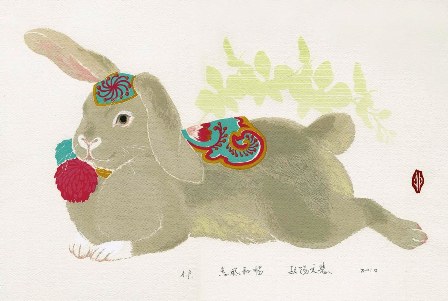

Ouyang Wen-hui’s “A Gentle Breeze is Freely Blowing” highlights a furry and playful rabbit sprawled in familiar and comfortable environment, thereby summing up the mood and spirit in the year ahead.

Cai Chun-yi’s “Jade Rabbit Announces Good News” captures the mood of a nation turning 100. Exploding fireworks on the Taipei 101 landmark usher in a year of celebration in exciting color. Taiwan keeps moving forward with power and speed like the bullet train on the high-speed rail.

Happy Year of the Rabbit to all!

Thursday, January 20, 2011

Rabbit seen only through a magnifying glass emerges from miniaturist Chen Forng-shean's hands to delight everyone


By Nancy T. Lu

Most people aim big in their endeavors. Chen Forng-shean has chosen to be different, devoting a lifetime to the pursuit of the opposite. The creation of scaled-down objects is his obsession. In fact, the smaller the size of the item, the greater the satisfaction it brings him.

Chen, a rare find, is a miniaturist from Xinchu, Taiwan. As the Lunar New Year approaches each year, he unveils his delightful masterpieces, which are often inspired by the zodiac animal of the year. They are barely visible to the naked eye

To welcome the Year of the Rabbit, he took resin and transformed it into “the world’s smallest rabbit.” Take note: the lovable creature measures only 0.5 mm in size. It is even more tiny than the eye of a sewing needle. Chen spent three months to produce a carrot-eating bunny. The rabbit, including its facial expression, can only be seen and appreciated under a magnifying glass.

Chen had the native rabbit in mind when he buckled down to make his rabbit conversation piece. He described the furry white animal as having a cleft palate, developed front teeth, short tail, long ears, short front legs and longer hind legs.

In the past three decades, Chen Forng-shean has built an amazing collection of miniature items. He displays many of them in his private museum at No. 17, Lane 207, Ankang Road, Sec. 1, Xinchu City. All those who have had the privilege of dropping by have been totally impressed by his skill. His accomplishments are indeed for the Guinness Book of World Records.

Thursday, January 13, 2011

Breton singer Yann-Fanch Kemener traces trail of “Nan Kuan” expert Tsai Hsiao-yueh, later meets designer Sophie Hong and erhu artist Liang Wen-pin


By Nancy T. Lu
East is East and West is West. But artists of different art forms and genres can make the meeting of the two happen with interesting result.


Yann-Fanch Kemener, one of the best-known voices from Brittany in France, touched down on Taiwan soil for the first time in December for a two-week visit. The specialist in traditional vocal music called “Kan Ha Diskan” (translated “call and response singing”) headed straight for Tainan to trace the trail of Tsai Hsiao-yueh, a singer of the most refined ancient Chinese music called “Nan Kuan” (southern pipe).


Tsai did a first recording of “Nan Kuan” ballads with an ensemble of musicians from Nansheng Association for Radio France in Paris in 1982. The critical acclaim received by this first “Nan Kuan” music album led to subsequent recordings for two more volumes in September and October 1991.

Kemener, himself involved in Breton roots revival, spoke in Taipei of his great admiration for Tsai’s traditional singing whom he first heard through her “Nan Kuan” recordings. He had made the special trip to the southern city of Tainan in Taiwan to hpoefully find her and interact with her. But he never met her. Instead he had very friendly encounters with people who knew her. In fact, he encountered Chen Hung-ming, a 92-year-old pipa or lute player who was in Tsai's entourage of musicians when she went to do recordings for Radio France in Paris thrice.

Kemener, one of just a handful of existing recognized mentors in traditional Breton singing, has likewise done many professional recordings of ballads in a language which he described as of Celtic origin and totally different from French. He performs in live concerts usually with a cellist or a pianist.

Born in Sainte-Tréphine (Côtes-d'Armor) in 1957, Kemener participated in the revival of the Kan Ha Diskan in the 1970s and 1980s. He helped in preserving the traditional songs by collecting and singing them in his beautiful and powerful voice. In Taipei, he expressed his interest in finding a publisher for a collection of 200 ballads in due time.

Kemener hailed from a family of tillers of the soil. Although exposed to a life of hardships, he found everyday joy in singing. Traditional singers of Brittany particularly fascinated him from childhood. He listened closely, eventually even taping their singing.


While in Taipei, Kemener tracked down top Taiwanese fashion designer Sophie Hong whose chic clothes he first discovered in Brittany and, in fact, has taken to wearing in his concerts and public appearances in the last 10 years. At Sophie Hong’s boutique in Taipei, he shopped to his heart’s content for his new wardrobe fashioned out of Chinese silk treated and processed using an ancient method for his coming performances in France.

One evening Sophie Hong invited him to dinner at the famous teahouse and restaurant with history called Wistaria. The setting was once the hub of workers in Taiwan’s earliest democracy movement. Christophe Gigaudaut, the French diplomat overseeing cooperation and cultural affairs for the French Institute in Taipei, joined them.


Sipping of aged Puerh tea circa 1950 from Lanchang -- said to have been wrapped and kept dry in a special straw mat of the region – combined with erhu music entertainment by Liang Wen-pin, a gifted artist of the two-string instrument and also a conductor of at least two Chinese orchestras in Taiwan, made the East-West encounter truly memorable for all.


After bowing classical Chinese musical notes inspired by the romance of the “Butterfly Lovers” Liang Shan-po and Chu Ying-tai, the erhu artist ventured into music suggesting the excitement of horsing around.

The moment finally came for Kemener to fill the air with his Breton style of singing. He sang in his native dialect and Liang caught up with him in his music-making by repeating his tune like a refrain after him. Was this like the “Kaner” singing and the “Diskaner” responding in a unique performance of “Kan Ha Diskan”? .

Kemener was drunk not with whisky nor with the special tea poured for him. He felt overwhelmed by the experience of traditions of East and West meeting in his rendezvous with newfound friends in Taiwan.

He earnestly expressed interest in returning despite his fear of flying to teach and conduct a workshop in his area of musical expertise.

Friday, December 10, 2010

Starry, Starry Night – from UNICEF Christmas card artist Manuel D. Baldemor


By Nancy T. Lu

Generosity gets manifested in many wonderful ways at Christmastime. Famous artists around the world, for example, offer the reproduction rights to their paintings to the United Nations Children’s Fund. Corporate interest in buying UNICEF Christmas cards to contribute to efforts to help malnourished and impoverished children around the world has been sustained over the years despite the trend to go for digital cards because the colorful greeting cards feature designs with great appeal.


To look at the paintings of Philippine-born artist Manuel D. Baldemor is to understand readily why his works revolving around the festive Christmas theme have been selected for reproduction on UNICEF cards over the years.

Every labor of love coming out of Baldemor’s atelier in Pasig, Metro Manila, feels very much like Christmas. He fills his Philippine Christmas landscape with traditional Philippine Christmas lanterns, which hang on windows and in front of homes at this time of the year. The star-shaped decorations shine beautifully in the night. The bright and exciting colors from Baldemor’s palette spread the joy of the season.


Traditions are very close to the heart of this 63-year-old native of the famous woodcarving town of Paete in Laguna province. He portrays Filipino farmers from the countryside taking time out to go and hear the Midnight Mass on Christmas Eve. Some show up even on the backs of water buffalos. The colorful Philippine jeepney likewise brings people to church. Vendors balancing baskets of food for the Noche Buena on their heads also find their way into his paintings.

Baldemor’s stylized depictions of Christmas celebration remind viewers that Christmas is a religious feast in predominantly Catholic Philippines. The façade of a house of worship – often Baldemor’s hometown church – is incorporated into his art composition from time to time. The Filipino family, too, gets highlighted in his well thought out art expression about Christmas. He paints townsfolk looking out of the windows of their homes.

The titles, which Baldemor gives his paintings, tell about the traditional Filipino culture, which fascinates him and which he holds dear. These include: “Pasko Sa Aming Bayan (Christmas in the Philippines),” “Season of Hope,” “Stars,” “Lantern Festival,” “Stars of Good Blessing,” “Midnight Mass” and “Filipino Family.”


The generous Baldemor has contributed at least 15 designs to UNICEF cards since 1986. Some of the original paintings are still in his personal collection.

The processing of a work of art for use on a UNICEF card takes about four years. A slide of the painting is sent to the UNICEF head office in New York for evaluation. The actual painting is never brought over there.

Greeting cards featuring Baldemor’s paintings have all been best-sellers. Such knowledge truly fills the painter’s heart with happiness.

Baldemor, in fact, created a mural titled “Pasasalamat” (Thanksgiving”) for the lobby of the UNICEF Building in Vienna, Austria. The mixed media masterpiece even required Baldemor to bring 50 kilos of lahar sand to Vienna. It was unveiled in 1998.

The friendly and outgoing Baldemor is not just a painter but also a sculptor, printmaker, and book illustrator. At the age of 12, he was already a “master carver” in Paete. Years ago, he even dabbled in ceramic tile design.

Baldemor studied fine arts at the University of Santo Tomas in Manila. He went on to win painting competitions and represent his country at international exhibitions like the Salon International Art in Paris.

Baldemor’s earliest drawings were in black and white. But his paintings have exploded in all the brightest colors imaginable. And art collectors just love them.

Today Baldemor – the father of three and grandfather of five – is considered one of the most productive and most appreciated contemporary painters in the Philippines. There is hardly any Filipino artist who can match his record for the total number of one-man shows held in his professional art career – to be exact, over 100 in all.

He travels abroad often, returning to showcase the creative results of his inspiring sojourns. Many travel grants from governments have enabled him to get to know first-hand the cultures of different countries on different continents.

When Baldemor was young, he wanted to be a poet. He now writes occasionally about his travels for the mass-circulation newspaper Philippine Star.

Wednesday, December 8, 2010

Getting misty-eyed over Xmas lights on Policarpio Street in Mandaluyong, Metro Manila


By Nancy T. Lu

Memories of Christmas lights brightening up almost the entire Policarpio Street in Mandaluyong, Metro Manila, four years ago make me misty-eyed. My first visit there happened during my last Christmas holiday with my father.

Arriving at Policarpio Street in Mandaluyong, Metro Manila, just a few days before Christmas brought out the hidden child in me. My father, too, was overwhelmed to see an entire neighborhood in Barangay Zuniga glow with the heartwarming joy of the Christmas season.

December in the previous seven or eight years at least, I was told, had meant skyrocketing electricity bills for the community. Some belt-tightening homeowners were forced a few years ago to drop the whole idea of keeping the tradition.

I was back in Manila for the first time in December after so many years of living and working in Taipei. I had heard so much about Policarpio Street as a tourist attraction.

Fortunately that year when I first visited Policarpio Street, Anthony Suva, the barangay captain, wanted to set a good example in showing the spirit of Christmas. So he went ahead and transformed his two-story residence into the most attractive House of Santa Claus.

Right across the Suva home was a huge mansion shining with a hundred thousand lights as in the past years. Even the gate, the walls and the tall water tank tower of this residential compound were covered with tiny lights. The sparkling ornamentation was indeed a joy to behold in the night.

Some residents opted to put up animated decorations that December. The story of the first Christmas all the way to the visit of the Three Kings was told with music playing in one moving display. Santa Claus riding away on a sled pulled by reindeers was the theme of the showcase on the façade of another house.

Vendors sold hot “bibingka” (rice cakes) and “puto bumbong” (glutinous rice steamed in bamboo tube), delicacies usually associated with the Midnight Mass on Christmas Eve, to the delight of the “balikbayan” (homecoming) crowd.

Word about the Yuletide celebration on Policarpio Street near Boni Avenue had gone around fast. The lighting ceremony in late November officially announced the arrival of the Christmas holidays. Visitors who turned up every night contributed to the festive atmosphere in the whole community. Volunteers assisted motorists in looking for parking space. .

Christmas lights and animated displays in Metro Manila such as the showcase on Philippine history at UNI-Mart in Greenhills that year reminded me so much of my happy childhood. My father always found time at the end of the day to drive the family around during the Christmas season.

We made the rounds of a few places like Caltex on Padre Faura, Coca-Cola Bottling Plant in Otis, Pepsi-Cola and Magnolia plants (completely giving way to condominium high-rises today) on Aurora Boulevard, C.O.D. Department Store in Cubao and Ysmael Steel on Espana Extension. We did this several times every year then. We even voted on the best or favorite display each year.

My father and my mother sent us, the children, to bed and dreamland only after putting us through an exciting drive around the city in those days when road traffic in Manila had yet to deteriorate into a big nightmare at Christmastime.

The mass-circulation newspaper Philippine Star carried on the front page a few days ago this year a big photograph showing that the lights are back on the big mansion on Policarpio Street. That the Christmas spirit is alive in that neighborhood is wonderful news.

Was it Fate that brought me back to Manila for the first time in December after so many years of living and working in Taipei? Looking back, I feel more than glad that I made that trip to Manila in 2006.

I saw my beloved father again during my Lunar New Year break not long after. But the angels took him away forever the following June. So now thoughts of Christmas lights on Policarpio Street leave me misty-eyed.

Wednesday, November 3, 2010

Chunky Move’s “Mortal Engine” combines choreography with interactive system and laser technology, says Obarzanek


By Nancy T. Lu

Gideon Obarzanek, a would-be scientist years ago, made a sudden turnaround, becoming a dancer and then a choreographer. He now brings to Taipei for the first time the Australian dance company called Chunky Move to stage a production involving tracking systems and laser technology titled “Mortal Engine.”

Obarzanek promised a “sophisticated live performance on stage.” As he put it, “No two performances are ever quite the same because the light generated to create the performance is made from dancers’ movement. What dancers do shapes the changing figure around them.”

Many choreographers in the 20th century turned to the projection of images in dance. Obarzanek cited particularly Alwin Nikolais and his use of video and film projections to distort perceptions of human body. But the late choreographer encountered problems. Video and film materials must be prepared in advance. They ran on fixed time. Dancers must keep rehearsing to be at the right place at the right time.


Obarzanek himself experienced similar frustration in the projection of images. This was until he stepped into new ground involving collaboration with German computer engineer Frieder Weiss.

Weiss was an expert in creating quality control system for production line components. He developed a series of cameras which looked at components on production lines to track down defects and abnormalities.

In his spare time, Weiss experimented with the technology from Bosch Engineering by applying it on his partner who was a dancer. In short, what was intended for industrial use became tracking technology for artistic pursuit, said Obarzanek.

After meeting Weiss at a conference in Europe, Obarzanek invited him to work with him in 2005. They showed each other their works and then discussed the possibility of a collaboration.

A solo titled “Glow” became their first project together. This choreographic essay showed a change in the perception of the body, explained Obarzanek. A combination of movement, speed and images distorted the perception of the human body, which shifted to cause it to sometimes even acquire animal qualities. Such change affected the choreography.

The successful work, however, could only go into very specific exhibition spaces with spectators sitting around and looking down at the performers on the floor, according to Obarzanek.

In 2007, Obarzanek convinced interactive system designer Frieder Weiss to develop more tracking systems for a larger work, which could go into the more conventional theaters. As a result, the relationship between the video and the dancers in what was to become “Mortal Engine” got more complicated.


Obarzanek elaborated: “Video began taking dimension from dancers. Video used behavioral mathematical algorithms to acquire life (sometimes disturbing as seen in the black patches) of its own.”

At this point, Obarzanek also thought of exploring new space – particularly the void above the audience in a theater. Laser and sound artist Robin Fox through his works in Melbourne got the choreographer’s attention.


“And so Robin Fox took the contours of the dancers and then gave the information to the laser, shifting the movement in the choreography from the stage into space with the audience drawn into the work itself,” recalled Obarzanek.

“People felt the live-ness of the performance for they were put in a unique point in time and place,” stressed Obarzanek. “This was not just a live show.”

Obarzanek also brought music composer Ben Frost into the production.

“We imagined what we could do individually and we discovered in the studio what we never imagined,” Obarzanek said of the team behind “Mortal Engine.”

He added: “Collectively we were able to work out what we individually could not have.”

Choices had to be made along the way. There were no big clashes or conflicts among the involved artists. Obarzanek, however, claimed that he was the director.

Obarzanek was the guest speaker at the Boomerang Lunch hosted by the Australian Commerce and Industry Office in Taipei on November 3. In attendance were choreographers, dancers and representatives of the many prominent dance companies in Taiwan.

Chunky Move will present “Mortal Engine” at the National Theater in Taipei at 2:30 p.m. and 7:30 p.m. on November 6 as well as at 2:30 p.m. on November 7.

Sunday, October 24, 2010

World of wonder at Taipei Flora Expo sparks excitement ahead of opening on November 6


By Nancy T. Lu
The Taipei Flora Expo has yet to open on November 6. But already, the Pavilion of Dreams is fanning a lot of excitement. .

The Pavilion of Dreams at the Xinsheng Park has the theme of “Hope, Dream, New Horizon.” There are three sections: Five Senses Beyond Space and Time, Interactive Digital Video Center and Panoramic Interactive Theater. A tour of the pavilion is likely to require at least one hour.

Enter the first hall to watch in awe the programmed metamorphosis of a giant flower overhead to six different music soundtracks and constantly changing lighting.


The Interactive Digital Video Center invites a visitor to step into a circle of light in front of a picture and to move to animate the image. A bee, for example, suddenly flutters into view to look for pollen on a flower. Or, petal after petal drops from a beautiful bloom. There is also a long wall on which the silhouette of each new arrival is thrown. But this human shape while moving forward quickly changes into an animated and almost human insect.


The Panoramic Interactive Theater gathers a group at the center for a sweeping look at nature starting with the lotus lagoon. The magical journey through water and land takes off rapidly with everyone blinking their eyes in disbelief and with their spirit literally soaring. Whether from underwater or on a mountain top, Mother Nature takes everyone's breath away. Then comes once more the interactive part. Hands are encouraged to reach out and touch trees to animate images.

Queues at the Pavilion of Dreams are expected to be very long. Groups of 70 visitors will be allowed to enter every 14 minutes after Flora Expo officially opens. The site can ideally accommodate a maximum of 280 persons. But more are likely to be crammed into the space.

Get ready, therefore, to explore the Taipei Flora Expo. A world of wonder and charm waits to take everyone to an unprecedented high.